El Pardo
Los pacientes del doctor GarcíaEl Pardo is a military post and infirmary that first appears as the destination of an urgent, unexplained rescue. There, Guillermo García Medina treats a wounded man whose identity is deliberately concealed; the place becomes the starting point of Guillermo’s bond with Manuel Arroyo Benítez and, later, a shorthand for the power and protection surrounding Francisco Franco.
The wounded stranger
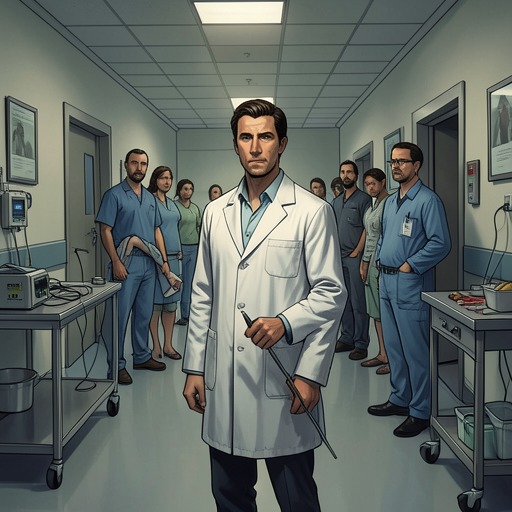
On the night Guillermo is summoned to El Pardo, Pepe tells him that a man there is near death and must not die. He cannot explain further. Guillermo is ordered to leave his hospital coat behind, put on the civilian overcoat Pepe has brought, and take some of the hospital’s bottles of blood. A car waits with its engine running. The hurried journey is governed by fear and secrecy, and Guillermo senses that the patient awaiting him will complicate his life in ways he cannot yet imagine.
The concealed patient and the post’s orders
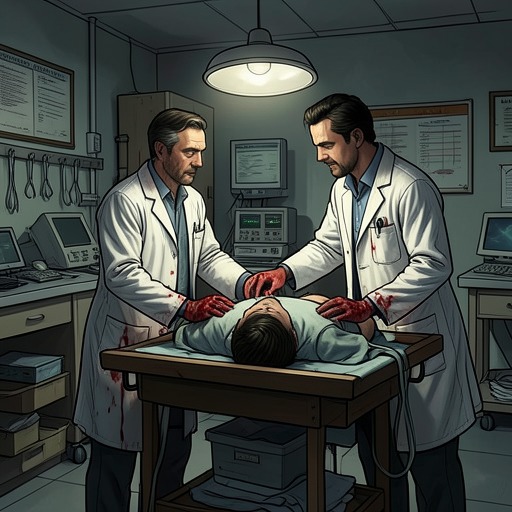
When Guillermo reaches El Pardo, he finds a man brought to the infirmary after a black car stopped outside the barracks shortly before eight in the evening. The car had no license plate or identifying marks. One passenger dragged a sack-covered man from the back seat, shot him three times, and climbed back in, leaving the guards with what they took to be a corpse. The wounded man had been shot in the side and chest, but none of the bullets had struck a vital organ. He had lost so much blood that Guillermo transfused a bottle of universal-donor blood before determining his blood group; it proved to be B positive. Asked for the man’s name, the people in the room gave no answer.
The secrecy surrounding the patient was institutional, not merely a matter of caution. A credential in his wallet identified him as Rafael Cuesta Sánchez, an official of the Public Order Council of the Defense Junta. The barracks commander telephoned the council and was told to remain on the line; a few minutes later, police commissioner Basilio Rodríguez called with instructions but no explanation. If Rafael was dead, he was to be buried as an unidentified person, without a registry entry. If he was alive, he had to be kept alive at any cost and admitted to no hospital under his name, lest someone try to kill him again. Rodríguez presumed that the commander, stationed at El Pardo, was a Communist, declared that he was one too, and demanded obedience without further questions, saying only that the wounded man was vital to the Republic’s interests.
The patient eventually reveals that Rafael Cuesta Sánchez is not his real name: he is Manuel Arroyo Benítez, known to friends as Manolo. He tells Guillermo this because Guillermo saved his life, though Guillermo still does not know what Manuel does, whom he serves, or why his true identity must remain hidden. El Pardo thus becomes the point where a false name first enters their relationship: the wounded man’s identity is initially a danger to be managed, then a confidence offered in repayment for rescue.
From a rescue site to a political shorthand
El Pardo’s importance extends beyond the infirmary where Guillermo saved Manuel. The post is presented as a place whose military authority intersects with the Republic’s clandestine security: Rodríguez’s orders make the patient’s survival a matter of state interest, while his true identity and the reason for the attack remain concealed. The scene leaves those reasons unanswered, but establishes the stakes that shape the location’s later associations: a man can be protected there only by hiding his name, and even the institution tasked with saving him is instructed to keep him outside ordinary records and hospitals.
Much later, Manuel invokes El Pardo not as a refuge but as the seat of an enduring power. In Buenos Aires, denouncing the shelter given to unpunished war criminals, he calls Franco “the assassin of El Pardo.” The phrase compresses the distance between the barracks of the rescue and the dictatorship that survives the war: El Pardo is no longer merely where a wounded Republican official was kept alive, but a metonym for Franco’s authority and the protection granted to those associated with it. Manuel’s accusation connects that protection to Perón’s hospitality toward fugitives and to the wider abandonment of Spaniards who had expected the world to oppose Franco.
That political meaning is reinforced by the novel’s return to the palace. In Guillermo’s later recollection, Franco rises from his bed at El Pardo each day and returns to it each night, while Rita insists that Spain’s condition cannot endure and that something must eventually happen. The repeated daily routine sets the ruler’s uninterrupted life against the suspended political hopes of those around Guillermo. El Pardo thus joins two scales of the story: the intimate beginning of Guillermo and Manuel’s bond, formed through emergency treatment and a secret name, and the long persistence of Franco’s rule, invoked as a daily reality that seems to outlast expectation.
The name and its afterlife
The novel makes El Pardo’s meaning accumulate through recurrence rather than through a description of the place itself. At the infirmary, the commander is told to protect a man whose identity must not enter official records; years later, the same location names the power Manuel holds responsible for protecting criminals. When he denounces Franco as “the assassin of El Pardo,” the phrase folds the secrecy of the rescue into the later history of impunity. The place signifies both a system capable of saving a life by concealing a name and a regime whose protection, in Manuel’s account, leaves other lives unaccounted for.
Guillermo’s closing recollection gives that association a quiet, repetitive form: every day Franco rises from his bed in the palace at El Pardo and returns to it at night. Against this unbroken routine, Rita says that Spain’s situation cannot last and that something must happen. Her expectation and Franco’s daily return occupy the same domestic present, but point in opposite directions—toward change and toward continuity. El Pardo consequently links the dangerous, improvised rescue that begins Guillermo and Manuel’s bond to the persistence of a political order that appears to survive every hope of its end.